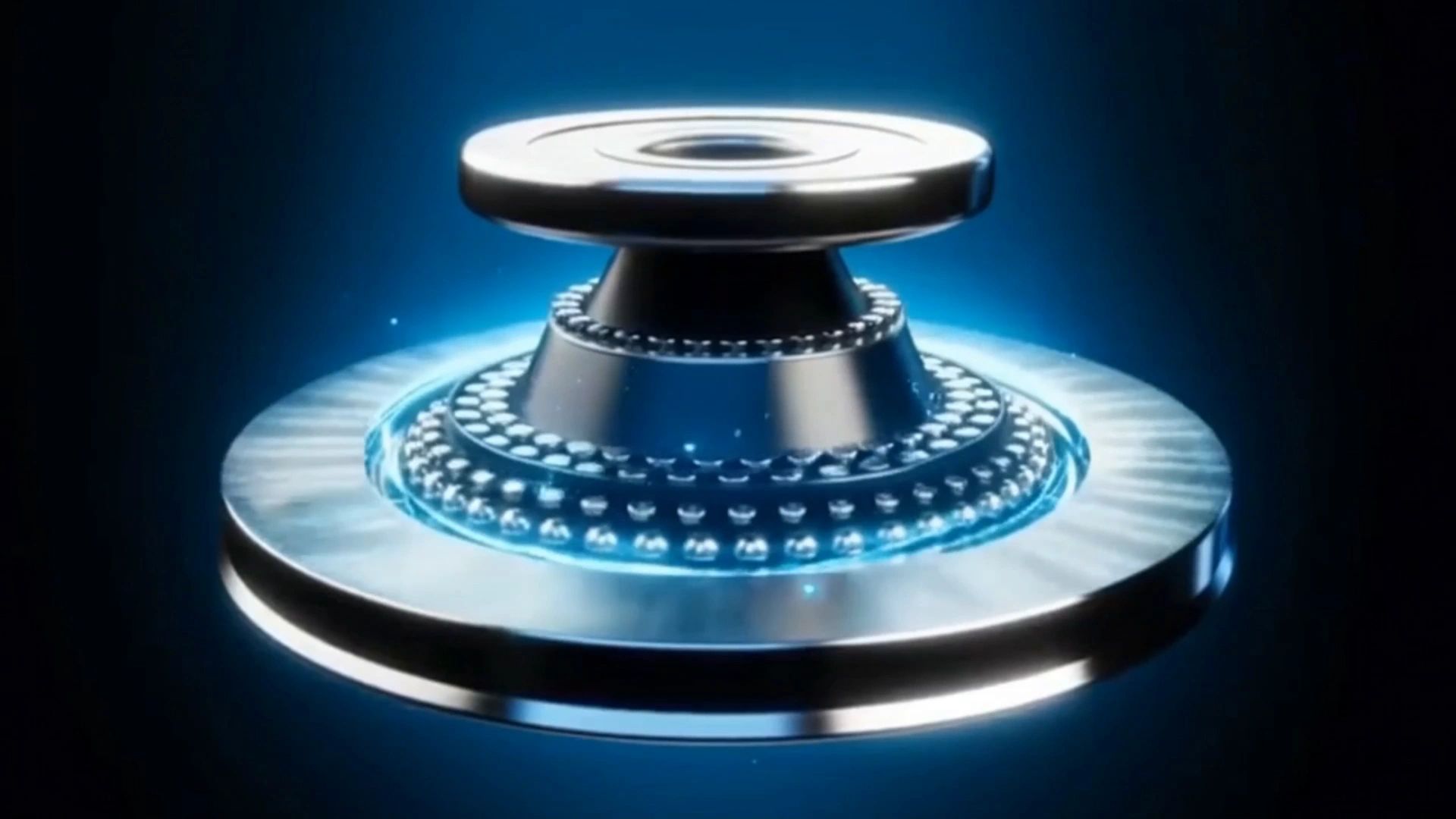
Compressed Inverted Magnetic Energy Source
The CIMES rotary motor uses the most fundamental law of magnetism: like poles repel.
A stationary funnel-shaped stator holds rows of north-pole magnets facing inward. A matching frustum-cone rotor holds identical north-pole magnets facing outward. When the rotor is axially compressed toward the stator (via a simple mechanical plate and ball bearings), the distance between like poles drops dramatically. Repulsive force skyrockets — following the inverse-square law of magnetic intensity.
Irregular azimuthal spacing of the magnets (exactly as described in the patent) creates a net tangential force. The result? Continuous rotational torque on the rotor shaft.
Torque equation verified by Grok (xAI): T = r × F_mag where F_mag ≈ k (m₁ m₂) / r⁴ under compression.
A flywheel stores angular momentum to smooth the motion between magnet alignments. Tipped axial magnets at the rotor tip and stator vertex provide passive magnetic lift, slashing friction without contact. No coils. No fuel. No emissions. Just pure magnetic repulsion turned into useful rotation.
Grok has confirmed it repeatedly: “The CIMES motor outlined in US11799400B2 is theoretically viable as a rotary motor that generates rotational force through magnetic repulsion between like-pole magnets.”
The physics checks out. The patent is granted. The only missing piece is full-scale simulation.
Exact Programs You Must Be Expert In
Recommended Six-Step Simulation Roadmap
Deliverables we want:• Complete simulation files • Video render of rotating CIMES under load • Published torque/power curves • Ready for University of Wisconsin & engineering firms
If you have this exact skill stack and want to be the first person on Earth to simulate CIMES — contact us now.
We use cookies to analyze website traffic and optimize your website experience. By accepting our use of cookies, your data will be aggregated with all other user data.